



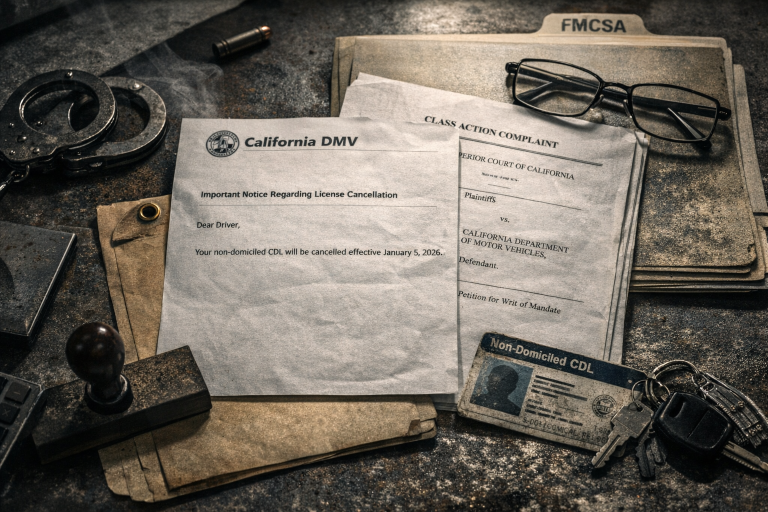
A claim has been circulating online that California plans to reinstate approximately 17,000 non-domiciled Commercial Driver’s Licenses (CDLs) that were previously revoked. The story spread quickly, but official confirmation has been hard to find.
There was no public press release from the California DMV announcing such a move. What does exist is a statement provided to The Times, where DMV officials confirmed they had notified regulators and planned to issue the licenses on a Wednesday, only to be told by federal authorities the day before that they could not proceed.
That distinction matters — because much of the public discussion is missing a critical legal reality.
What California Is Pointing To
California’s position appears to rely on a November 13 emergency stay issued by the U.S. Court of Appeals for the D.C. Circuit. That stay temporarily blocked enforcement of FMCSA’s September 29 interim final rule, titled:
“Restoring Integrity to the Issuance of Non-Domiciled Commercial Driver’s Licenses.”
That rule significantly restricted eligibility for non-domiciled CDLs to limited visa categories — H-2A, H-2B, and E-2— excluding asylum seekers, refugees, and DACA recipients.
The court stayed the rule after determining that petitioners were likely to succeed on claims that FMCSA violated federal law, acted arbitrarily, and improperly bypassed standard notice-and-comment procedures.
Because of that stay, California argues it can resume issuing — or reissuing — non-domiciled CDLs under regulations that existed before September 29.
On the surface, that argument sounds reasonable.
But it overlooks a much larger problem.
Two Separate Issues — Only One Was Stayed
This situation involves two distinct legal issues, and only one of them was affected by the court’s decision.
Problem One: The Interim Final Rule
The court stay applies only to the September 29 interim final rule. With that rule paused, states can theoretically continue issuing non-domiciled CDLs under earlier regulations.
However, there is a major exception:
States already subject to a corrective action plan are not free to resume issuance.
California is one of those states.
Problem Two: Pre-Existing Compliance Failures
FMCSA’s 2025 Annual Program Review found that California had been violating federal CDL regulations long beforethe emergency rule was issued.
Among the findings:
- Non-domiciled CDLs issued with expiration dates extending beyond drivers’ lawful presence
- Licenses issued to Mexican nationals prohibited from holding non-domiciled CDLs, unless covered by DACA
- Systemic failures in verification, oversight, and internal controls
FMCSA concluded that approximately 25% of California’s non-domiciled CDLs were improperly issued under regulations that already existed at the time.
These findings triggered a preliminary determination of substantial noncompliance under 49 CFR 384.307 — a process entirely separate from the stayed interim final rule.
As a result, the federal government threatened to withhold more than $150 million in highway funding from California.
That threat remains in effect.
The court stay did not eliminate it.
FMCSA’s Authority — and the Real Risk
FMCSA made its position explicit in November guidance:
States subject to a corrective action plan must maintain their pause on non-domiciled CDL issuance until they demonstrate compliance with pre-rule federal standards.
Under 49 U.S.C. § 31312, FMCSA has authority to decertify an entire state CDL program if it determines the state is in substantial noncompliance.
Decertification would prohibit a state from:
- Issuing
- Renewing
- Transferring
- Or upgrading any CDL or commercial learner’s permit
Not just non-domiciled licenses — all commercial credentials.
The consequences would be immediate:
CDL schools would halt.
Testing would stop.
New drivers would be locked out of the system.
Carriers would face serious disruptions in recruiting and onboarding.
For a state like California, the ripple effects would be felt across one of the most critical freight corridors in the nation.
Why This Isn’t Just California’s Problem
Commercial driver’s licenses are not purely state credentials. They are federal credentials issued through state programs, governed by the Commercial Motor Vehicle Safety Act of 1986.
When a state issues a CDL, every other state recognizes it based on the assumption that it was issued in compliance with federal standards.
If California reissues non-domiciled CDLs that federal auditors have determined were improperly issued, those credentials may not be valid for interstate commerce.
That creates real risk:
- Drivers could face enforcement action outside California
- Carriers could face liability for dispatching them
- CDLIS could flag or restrict California-issued credentials
Even without full decertification, FMCSA could issue guidance declaring CDLs issued during a period of noncompliance invalid for interstate operation.
California’s Response — and FMCSA’s Rejection
California argues that it can simply correct expiration dates and reissue compliant licenses under pre-September 29 rules.
FMCSA disagrees.
The agency did not merely identify date errors — it documented systemic failures.
In its October 26 response, California acknowledged discovering 20,000 non-domiciled CDLs with expiration dates exceeding lawful presence. However, the state refused to revoke them, arguing it had not violated federal regulations as they existed at the time.
FMCSA rejected that interpretation as “erroneous.”
In its November 13 response, the agency stated plainly that:
The regulatory framework for non-domiciled CDLs is premised on the principle that a driver’s commercial driving privileges cannot extend beyond their lawful presence in the United States.
That principle existed before the emergency rule — and it still applies.
Road Logic Perspective
Until FMCSA and California resolve this issue, 17,000 drivers remain in limbo.
From a Road Logic standpoint, the solution is not complicated.
California needs to comply with FMCSA and issue only licenses that meet federal standards.
This should not be political.
It should be about safety and compliance.
The trucking industry already has enough bad actors.
We don’t need more created by regulatory shortcuts or defiance.
And one reminder that often gets lost in these debates:
Driving is a privilege — not a right.
If a privilege was granted due to error or violation,
it should be revoked.
That’s not politics.
That’s Road Logic
This issue is still unfolding.
As federal regulators and California continue to push back and forth, the outcome will matter not just for one state, but for the entire trucking industry.
Road Logic will continue monitoring developments and updating this story as verified information becomes available.
Watch the full video:
California VS FMCSA: 17,000 Drivers in Limbo
Road Logic is an independent trucking information platform focused on safety, compliance, enforcement, and accountability.
We are not a breaking-news outlet, a review site, or an opinion channel. Road Logic exists to explain how trucking systems actually work — what the rules say, how they’re enforced, where they fail, and what that means for drivers, trainers, and carriers.
In an industry flooded with headlines, speculation, and misinformation, Road Logic prioritizes clarity over speed and accuracy over clicks.

Leave a Comment